The Administered Man
A salaryman is not merely a man who earns a salary.
He is a man who has outsourced sovereignty.
His bargain is simple: "Tell me what to do, give me a rank, give me a script, punish me mildly when I fail, and in return protect me from the terror of self-authorship."
The salary is not only money.
It is absolution.

The job says: you do not need to decide what life is for. You do not need to decide what to build. You do not need to face the market directly. You do not need to be judged by reality nakedly. You only need to be judged by a manager, a process, a KPI, a calendar, a quarterly review.
That is spiritually comforting to certain men.
The salaryman's hidden religion is permission.
Permission to rest.
Permission to travel.
Permission to speak.
Permission to stop working.
Permission to be sick.
Permission to be important.
Permission to exist.
This is why the salaryman is not only an economic type. He is a psychological and spiritual type. He is the man who has been trained to experience hierarchy not as a ladder to command, but as a substitute for command.

He does not ask: "What should I build?"
He asks: "What is expected of me?"
He does not ask: "What is true?"
He asks: "What is acceptable to say?"
He does not ask: "How do I found a house?"
He asks: "How do I keep my position?"
The deepest tragedy is that he often mistakes this for adulthood.
But much of what he calls adulthood is merely domestication.
A man humiliated by parents may seek that same humiliation in a job. Not consciously. He does not say to himself: "I want to be degraded." He says: "This place is serious. My boss is demanding. This is what responsibility feels like."
But the nervous system often confuses familiarity with safety.
If his childhood hierarchy was: dominant parent, frightened child, unpredictable approval, shame as discipline, then corporate hierarchy can feel like home. Not pleasant home. But known home.
The tyrannical boss becomes father.
HR becomes mother.
The company becomes family.
Performance review becomes confession.
Promotion becomes parental love.
Salary becomes allowance.
The deeper wound is not merely that he was shouted at. It is that his will was never allowed to become sovereign. His inner command faculty was damaged, mocked, interrupted, or never trained.
So when he reaches adulthood, freedom does not feel like opportunity.
It feels like abandonment.
This is the essence of infantilisation. The infantilised man does not merely avoid responsibility. Often he does not even perceive responsibility as a real category available to him. He sees choices only inside the cage: which job, which credential, which manager, which apartment, which approved lifestyle.
He does not see the cage itself as optional.
It is like a domesticated animal whose gate is open. It does not escape, because the open field is not recognized as freedom. It is recognized as danger.

This is why infantilisation is more damaging than ordinary hardship. Hardship can produce strength. Infantilisation prevents the formation of agency itself.
The salaryman fears responsibility because responsibility means there is no parent left to blame. No manager, no system, no unfair boss, no company politics. Just reality. The market. The woman. The child. The body. The clock. The bloodline. The result.
The great tragedy is that many men do not discover their own will until very late, if ever. They think they are tired from work, but they are actually tired from lifelong self-suppression.
The first awakening is usually not ambition.
It is disgust.
A clean, cold disgust at being managed like livestock.
Then comes anger.
Then grief.
Then responsibility.
Then command.
The Polish Case
In Poland, this class is historically very recent.
A large part of today's Polish office class is only two or three generations removed from peasants, smallholders, village craftsmen, or first-generation workers. The grandfather's world was land, animals, weather, tools, neighbours, church, hunger, family honour, physical competence.
Then came war, communism, industrialisation, urban migration, mass schooling, bureaucracy, apartment blocks, factories, offices, ministries, technical institutes, state hospitals, state schools.
The peasant's son did not become a bourgeois proprietor.
He became administered.
That is the key distinction.
A true bourgeois class develops through property, trade, inheritance, contracts, family firms, guild memory, risk-taking, credit, reputation, and intergenerational command.
Poland's twentieth century largely interrupted that development. War killed or displaced elites. Communism attacked private capital and independent institutions. The new route upward was not: build, own, command.
It was: study, obey, pass exams, enter institution, receive allocation, get apartment, get position, do not stick your neck out.
The village patriarch was replaced by the Party, then by the manager, then by HR.
Poland is especially interesting because family farms survived more than in the Soviet Union. The land was not erased entirely. But the status ladder changed. The ambitious child was told: leave the village, get education, get a secure position, do not be like us.
That sentence contains both love and poison.
The old world said: inherit land, marry, work, endure, reproduce, defend the household.
The new world said: escape the mud, speak properly, enter the city, respect the office, respect the superior, be grateful, do not act like an owner.
That produced a psychic mutation.
The grandfather's world was concrete.
The father's world was institutional.
The son's world became corporate.
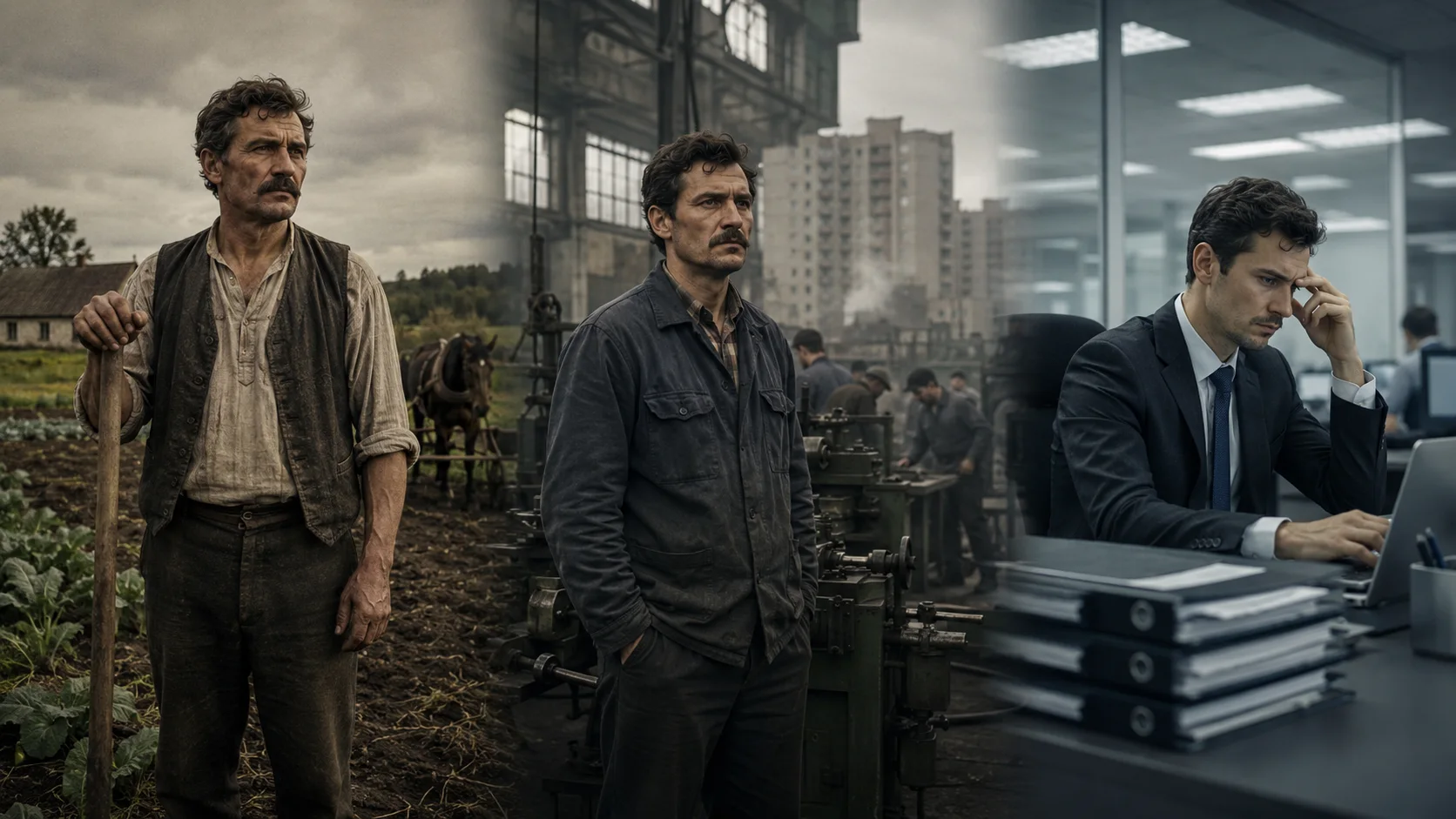
Grandfather: land, animals, weather, tools.
Father: factory, queue, state job, apartment block, Party cynicism, scarcity, "kombinować."
Son: laptop, mortgage, English phrases, calendar invites, Slack, LinkedIn, therapy language, performance review.
So yes, the salaryman is often a deracinated peasant-descendant. But he has lost the peasant virtues while not gaining bourgeois virtues.
He often lost endurance, practical skill, family rootedness, land-sense, reproductive seriousness, physical courage, local reputation.
He did not fully gain ownership mentality, commercial aggression, contract culture, independent judgement, long-horizon capital accumulation.
What replaced both was credential obedience.
This is why the class can seem spiritually thin. It has neither the dignity of the peasant nor the command of the proprietor. It is suspended between worlds.
The ambitious Polish child of the twentieth century was taught that institutions wash the mud off your boots.
So he became status-anxious.
He is terrified of looking like a "wieśniak," but he has no aristocratic ease. He imitates managerial manners. He worships "normalność." He fears conflict. He wants approval from institutions because institutions certified his escape from the village.
And because his family sacrificed for his education, he feels guilt about risk.
To quit a stable job is not merely a career move. It feels like betraying the ancestral escape from poverty.
His grandmother says: "Masz dobrą pracę, nie kombinuj."
That sentence is the whole prison.
There is also a selection effect. The strongest descendants of farmers may not become salarymen. Some become entrepreneurs, builders, tradesmen, emigrant operators, black-market survivors, local bosses, men who still carry practical command.
The office salaryman is often the line that converted ancestral survival energy into institutional compliance.
So this class emerged from rapid deracination plus blocked bourgeois formation.
First, land-based people were pulled into state-industrial modernity.
Second, private command and capital formation were suppressed.
Third, education became the ladder.
Fourth, institutions became surrogate parents.
Fifth, post-1989 capitalism imported corporations before Poland had fully rebuilt a native bourgeois culture.
The result: men biologically descended from hard stock, but psychologically processed into dependents.
Not because Poles are naturally like this.
Because the twentieth century repeatedly punished independent command and rewarded adaptive compliance.
The Western Price
In the West, the price can be even higher.
Not merely obedience of action, but obedience of perception.
The old Eastern Bloc demand was often: "Say the Party line publicly, even if privately everyone knows it is false."
The newer Western institutional demand is softer, more moralized, more therapeutic, but psychologically similar: "Demonstrate that your perception can be subordinated to the approved moral language of the institution."
That is why it feels so degrading.
The point is not merely whether one uses polite language. The point is whether the institution can make a man publicly affirm a formulation he experiences as false, incoherent, or humiliating.
Once he does that, he has crossed an inner line.
He has learned that career access requires self-betrayal.
This creates a special kind of salaryman: not just managed, but spiritually gelded.
He must split himself.

Public self: fluent in approved slogans.
Private self: resentful, ironic, cowardly, or numb.
Career self: smiling and compliant.
Inner self: shrinking, because it knows it has traded truth for position.
That split is corrosive. A man can survive hard work, low pay, hierarchy, even unfair bosses. What destroys him more deeply is being required to lie about reality while pretending the lie is compassion, sophistication, or professional etiquette.
The evolutionary meaning is simple: institutions test submission before granting status.
In older systems, this might be military discipline, religious orthodoxy, court etiquette, aristocratic manners, Party loyalty, or corporate culture.
In the current Western professional class, moral-linguistic conformity has become one of the key submission rituals.
The function is not primarily truth-seeking.
It is sorting.
Who will resist?
Who will comply?
Who will denounce others?
Who can be trusted to repeat the formula?
Who is safe to promote?
This is why the ambitious but weak man adapts quickly. He tells himself: "It is just words."
But words are not just words.
Words are allegiance signals.
A man who can be made to speak against his own perception can later be made to manage others against his own conscience.
That is how a clerk is manufactured.
Not by poverty.
Not by employment.
But by repeated small acts of self-overriding.
The tragedy is that many men think they are buying comfort. In reality, they are selling the faculty that would have made them men of command: independent judgement.
The deepest humiliation is not that he must work for someone.
It is that he must pretend not to see what he sees.
Fertility and the Sterile Class
This mentality has reproductive consequences.
The administered man is not naturally oriented toward founding a house. He is oriented toward maintaining a position.
He thinks in monthly cashflow, not descendants.
He thinks in comfort, not continuity.
He thinks in permission, not command.
He wants certainty before marriage, comfort before children, approval before action. But children are anti-bureaucratic. They bring disorder, burden, risk, sacrifice, hierarchy, and irreversible responsibility.
The salaryman has been trained to hate exactly those things.
So the low fertility of the urban, educated, middle-class professional is not accidental. It flows from the structure of his life. Delayed marriage, delayed first child, career anxiety, mortgage anxiety, apartment life, status consumption, credential competition, fear of lost freedom, fear of lost lifestyle, fear of imperfection.
He becomes a man optimized for institutional survival, not biological continuation.

The dog becomes symbolically important here.
Not because every dog owner is sterile or decadent. Rural people have dogs. Families have dogs. Strong men have dogs.
But in the low-fertility urban professional class, the pet often becomes a soft substitute for household continuity. A creature to nurture without the terror of lineage. Affection without dynasty. Care without authority. Domesticity without reproduction.

It is family life without the metaphysical weight of family.
The urban, credentialed, institution-dependent class is structurally selected toward low fertility.
The rooted family proprietor has a reason to reproduce: land, business, name, house, continuity.

The traditional working or lower-middle man may reproduce because family remains normal, practical, expected.
The high-resource patriarch may reproduce because he has command, access, and intent.
But the atomized metropolitan professional is often reproductively confused. He has enough comfort to avoid urgency, enough anxiety to avoid risk, enough status to delay marriage, enough entertainment to dissipate desire, enough ideology to distrust nature, and enough institutional dependence to fear disorder.
His sterility is not mainly biological.
It is metaphysical and strategic.
He is not founding a line.
He is maintaining a lifestyle.
This is why an independent-minded man differs so sharply. The independent man does not necessarily reproduce more by default. A chaotic "free spirit" may reproduce less than a disciplined corporate man. Independence alone is not enough.
Male reproductive success requires resources, status, pair-bond access, courage, judgement, and willingness to assume patriarchal burden.
But a genuinely independent man with resources, command, and reproductive intent is in a different category from the sterile salaryman.
He sees women, children, property, household, name, and future as connected.

The salaryman sees them as separate lifestyle decisions.

That is the difference between a founder and an employee.
The Awakening
What makes a man wake up?
Not low agreeableness alone.
Not anger alone.
Not perfectionism alone.
These traits can help, but they can also deform him.
Low agreeableness helps because it makes a man less dependent on approval. He can withstand disapproval, conflict, being disliked, being called difficult. Without some disagreeableness, he remains socially hypnotized.
But low agreeableness without discipline becomes mere contrarianism.
Anger helps because it can become boundary energy. Anger says: "This is beneath me. This is false. This is intolerable."
But anger without discipline becomes rage, complaining, resentment, or rebellion against all authority. That is not manhood. That is boyhood with a louder voice.
Low tolerance for imperfection helps if aimed first at himself.
"My body is weak; fix it."
"My finances are dependent; fix them."
"My judgement is soft; harden it."
"My woman does not respect me; understand why."
"My work is servile; build leverage."
"My word is cheap; make it costly."
But if his intolerance is aimed mainly at others, it becomes neurotic contempt.
The deeper trait is not anger.
It is the inability to continue lying to oneself.
A man wakes up when the cost of self-betrayal becomes higher than the cost of conflict.
Often the trigger is humiliation.

A boss insults him. A woman loses respect for him. His father dies. His child is born. He gets sick. He realizes he is aging. He sees that nobody is coming to save him.
Something breaks the illusion that obedience will be rewarded with a meaningful life.
But awakening is only the first step.
Many men wake up and become cranks. They see the cage, but do not build anything outside it. They become bitter spectators of their own imprisonment. They mock the system, but still eat from it. They despise salarymen, but remain salarymen. They have perception, but no command.
That is not liberation.
That is resentment.
The real transition is when anger becomes command.
He stops asking for permission.
He accepts that responsibility is lonely.
He stops blaming parents, school, women, the state, the company, or history.
He builds physical strength, economic leverage, technical competence, social judgement, and household authority.

He learns to say no without theatrics.
He learns to say yes and then carry the burden.
He stops needing reality to be fair.
He stops confusing comfort with success.
He stops seeking parental love from institutions.
The formula is not:
low agreeableness plus anger equals real man.
The formula is:
disgust at submission, independent perception, disciplined aggression, competence, and accepted burden.
Low agreeableness is the immune system.
Anger is the ignition.
Competence is the engine.
Responsibility is the crown.
The Final Distinction
The salaryman is not condemned because he has a job.
A man can work for someone and still remain inwardly sovereign.
The problem is not salary.
The problem is administered perception, outsourced will, reproductive hesitation, and dependence on institutional permission.
A real man may have an employer, but he does not have a master in his soul.

He can see what is real.
He can say no.
He can carry burden.
He can found.
He can protect.
He can command himself before attempting to command others.
The salaryman seeks safety from life.
The real man seeks contact with reality.
The salaryman wants the world to give him a role.
The real man assumes one.
The salaryman asks: "What am I allowed to do?"
The real man asks: "What must be done?"
The salaryman lives under review.
The real man lives under consequence.
That is the difference.