Symbols Without Succession
A lot of "trad," stoic, dynastic, honour-based self-improvement content is symbolic consumption. It is men borrowing the aesthetics of aristocracy without the substance that made aristocracy real.
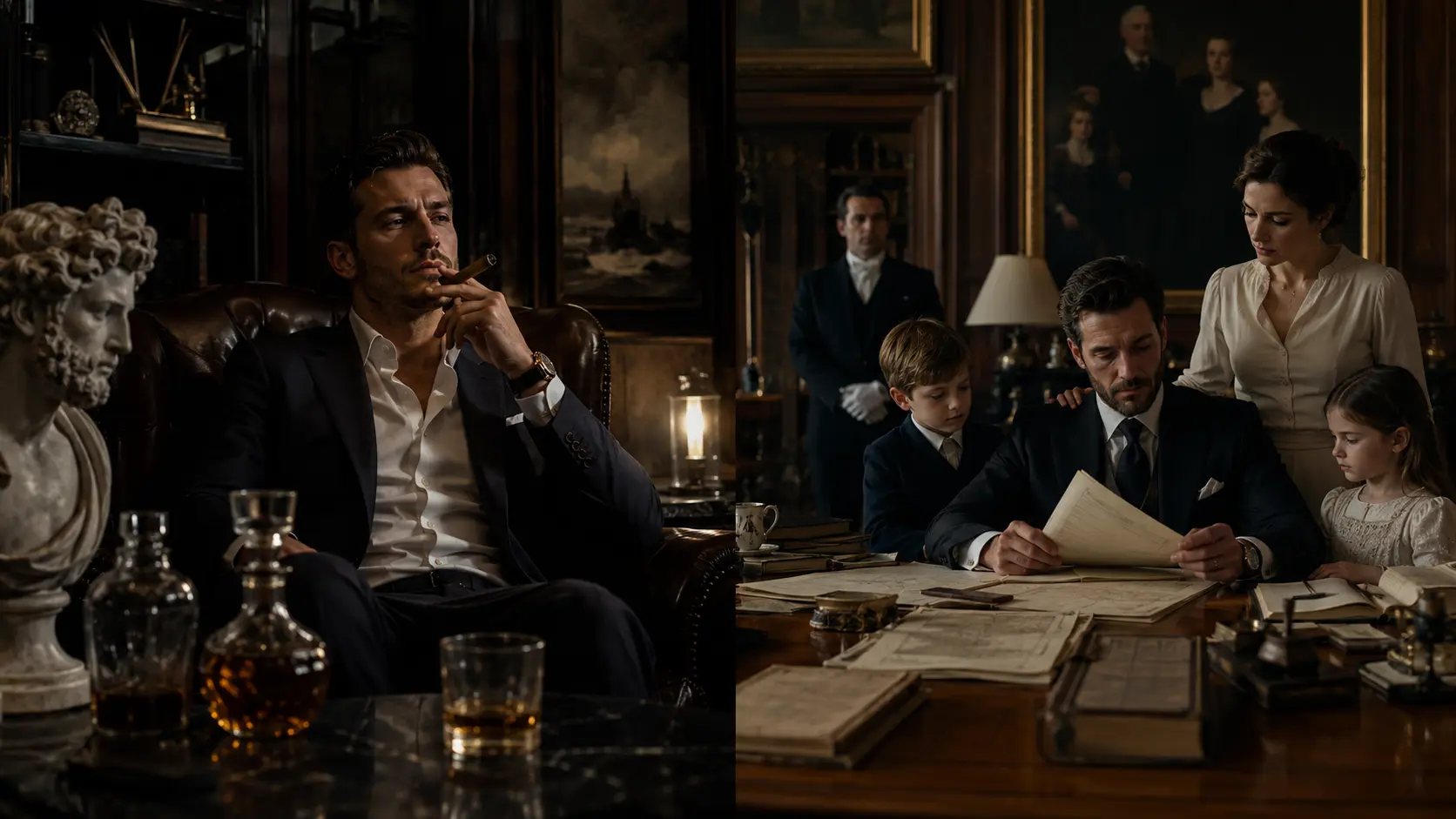
The modern moodboard aristocrat surrounds himself with cigars, suits, leather chairs, Roman busts, Latin phrases, cold plunges, deadlifts, brooding portraits, and quotations from Marcus Aurelius. He performs the visual language of command. But in many cases, there is no command. There is no house. No estate. No wife. No children. No dependents. No name to defend. No patrimony to transmit. No real burden.
This is why so much of it feels hollow. It is "dynasty" as an aesthetic, not dynasty as a biological, financial, and intergenerational fact.
Real aristocratic life was not mainly about refined taste. It was about continuity. Land, household, heirs, duty, reputation, patronage, command, marriage strategy, alliances, and the ability to transmit position across generations. The symbols existed because they were attached to structure. Detached from that structure, they become theatre.
A cigar in a study means one thing when the man smoking it has just settled an inheritance dispute, negotiated a marriage alliance, secured financing, protected his family name, disciplined a son, or decided the fate of people under his authority. It means something else when it is merely an Instagram prop beside a copy of Meditations and a protein shaker.
The mistake is to confuse the external signs of rank with rank itself.
Without children, capital, property, competence, and a real order to govern, the posture becomes costume. The man is not carrying a dynasty. He is consuming the feeling of being the sort of man who might have had one.
There is also a psychological irony here. Many of these men glorify honour, stoicism, discipline, and legacy precisely because they feel the absence of those things. The content becomes compensatory. A fragmented modern life is dressed up in the symbols of a coherent older one.
The man who constantly talks about discipline may not be disciplined. The man who endlessly invokes honour may not live inside any honour system. The man who speaks of legacy may have no heirs. The man who romanticises dynasty may be lonely, financially unstable, sexually undisciplined, and socially unanchored.
He is not wrong to admire the thing. The problem is that admiration becomes a substitute for embodiment.
A real patriarch does not need to constantly announce "discipline" and "legacy." He is trapped inside them. He has no choice. His wife, children, employees, creditors, partners, rivals, friends, and enemies all impose reality upon him. His decisions have consequences beyond his own mood. His failures do not merely embarrass him; they damage people who depend on him.
That is the difference. The cosplayer chooses symbols. The patriarch carries consequences.
Another error is that modern men often mistake aristocracy for freedom, when aristocracy was mostly constraint. The aristocrat was not simply a man with better taste. He was a man whose actions were not fully his own. His marriage, manners, debts, friendships, courage, cowardice, and scandals all reflected on a house larger than himself.
This is why honour mattered. Honour was not a vibe. It was a credit system.
A dishonourable man did not merely degrade his own image. He damaged the transmissible value of his name. He made his family less marriageable, less trustworthy, less bankable, less politically useful, less socially secure. Honour was not motivational content. It was social capital under constant audit.

The modern moodboard aristocrat wants the symbols of rank without the surveillance of rank. He wants the cigar, the study, the maxims, the body, the expensive woman, the martial imagery, the stern vocabulary. But he does not want the generational accounting. Not the wife who must be protected. Not the children who must be formed. Not the household that must be governed. Not the employees who must be paid. Not the estate that must be maintained. Not the alliances that must be preserved. Not the name that must survive him.
He wants the feeling of nobility without the obligations that made nobility noble.
Even friendship is transformed by this distinction.
In the moodboard version, friendship is mostly vibe-sharing. Men send each other podcast clips. They bond over gurus, memes, cigar nights, gym talk, political takes, luxury aesthetics, and videos where some commentator "destroys" or "puts someone in his place." It is spectator masculinity. They consume displays of dominance by proxy and mistake shared entertainment for brotherhood.
This is camaraderie without enterprise.
Real aristocratic friendship was much closer to alliance. Men were bound by shared ventures, mutual risk, capital, patronage, marriage connections, secrets, introductions, favours, disputes, and common enemies. Friendship was not merely "we like the same things." It was "our interests, names, houses, and futures are partly entangled."
A serious friend was not only someone amusing. He was someone who could be trusted with consequence. Someone who could introduce your son, vouch for your character, defend your reputation, help settle a dispute, stand beside you in danger, tell you an unpleasant truth, support a venture, or restrain you from a foolish one.
The moodboard aristocrat has companions for stimulation. The patriarch has allies for consequence.
This is why so much modern masculine content feels adolescent even when it uses old-world imagery. It is obsessed with the appearance of command but avoids the structures that create command. It wants hierarchy without household, legacy without lineage, honour without reputation, brotherhood without shared objectives, and discipline without duty.
The older world was not romantic in the way the internet imagines it. It was harder, narrower, more judgmental, more binding, and more unforgiving. Its virtues were not lifestyle preferences. They were survival traits for men whose private conduct had public consequences.
Stoicism, in that setting, was not a brand. It was the emotional technology of men who could not afford collapse.
Honour was not a caption. It was the invisible currency of trust.
Dynasty was not a mood. It was children, property, law, memory, blood, marriage, capital, and time.
Discipline was not a morning routine. It was the daily submission of appetite to an objective beyond the self.
That is what is missing from the cosplay version: the objective beyond the self.
The modern self-improvement aristocrat often remains fundamentally narcissistic. His body, his style, his routine, his taste, his status, his women, his image, his optimisation. Even when he speaks of tradition, he is often still orbiting himself. Tradition becomes another way to decorate the ego.
The real dynastic frame reverses this. The man is not the end point. He is a bridge. He receives, preserves, improves, and transmits. His life is not merely his own. He stands between ancestors and descendants. He is judged by whether what passes through him emerges stronger or weaker.
That is why the real version is heavier and less theatrical than its online imitation.
It is not a solitary man arranging symbols around himself in order to feel anchored. It is a man whose life is embedded in obligations that do not disappear when the mood passes: wife, children, household, work, debts, allies, dependents, reputation, inheritance.
The difference is not mainly aesthetic. It is structural.
One uses the language of continuity to decorate the self.
The other is bound by continuity, whether he feels inspired by it or not.